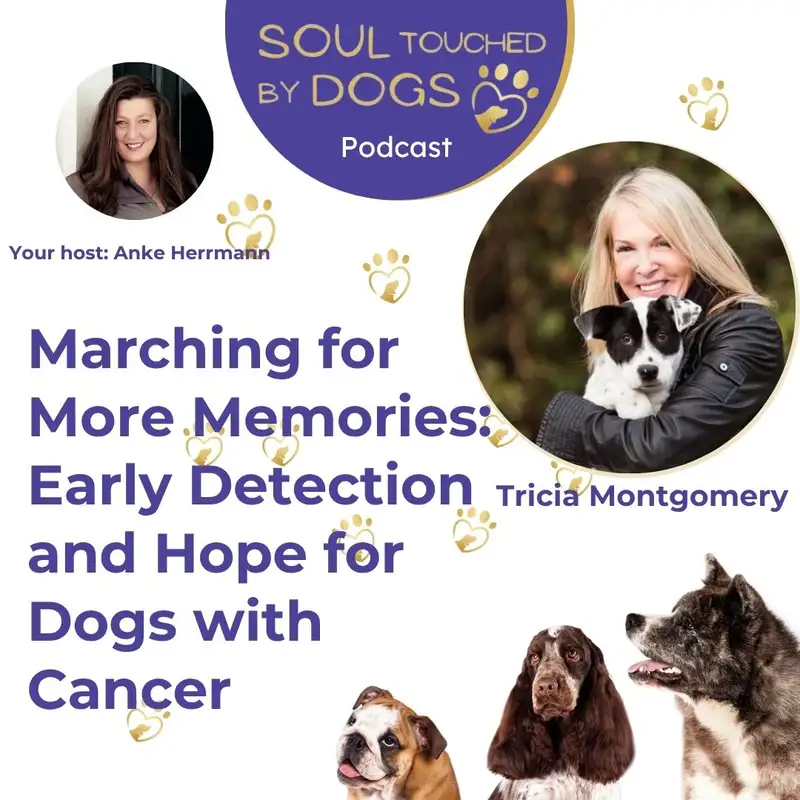
Tricia Montgomery - Marching for More Memories: Early Detection and Hope for Dogs with Cancer
Welcome to the Soul Touched by Dogs
Podcast, the show for dog lovers who
see dogs not as toys or tools, but
wise souls worth our respect and care.
I'm an Herrmann, and I'm your host.
I talk to poor some humans, people who
do great work for dogs and their people.
So come and join us for
today's conversation.
Anke: Hello and welcome Tricia.
I'm super excited to have you here today.
Tricia: I am excited to be here.
Thank you for having me.
And what an honor.
Thank you so much.
Anke: My pleasure.
I'm really looking forward to
this particular conversation.
So before we dive in, let people know
where in this lovely world you are, and
as always, what's your business with dogs?
Tricia: Absolutely.
So I am actually in Florida.
I am located outside of Fort
Myers, and it's about 83 degrees
here and absolutely beautiful.
And if I had the, uh, the screens
open right now, you'd see the water
and the canal and, uh, ab I always
say I wake up in paradise every
morning, which is absolutely beautiful.
Um, I had been in.
Welfare, the veterinary
profession and the pet industry.
Um, I'd like to say pretty much my whole
life, I, you know, I, I look like I'm
25, but I'm a little bit older than that.
I, um, I started with the
Chicago Veterinary Medical
Association about 25 years ago.
I started as their public education
director and then went on to
become their executive director.
And so I really grew up in
the veterinary profession and
understanding everything about that.
Um, I then went on to, um, uh,
be in the pen industry with my
organization, uh, which was Canine
Fit Club, which was gyms for people
and dogs all across the country.
We had everything from Papa Lots NAMA
at State Bow Wow Bootcamp, BA begging
for beginner ba I mean, you name it.
And we created science-based programs
for both people and their dogs, and I.
Worked with Dr.
Ernie Ward, association of
Pet Obesity Prevention and Dr.
David Levine as we were
selling the company.
I, uh, I really wanted to focus on
animal welfare because I had been, um,
I'd always volunteered, I always been
on boards for different animal control
organizations in humane societies.
And, uh, put my, put my name out there
and I became CEO for P mean society,
and I led it straight into the pandemic.
And straight out of the pandemic.
So unchartered waters to be for sure.
But during that time, um, it was
during the time of COVID and it
was my birthday and it was the
worst birthday ever, as we know.
During COVID it was like really
everything was locked down, but
we were deemed essential workers.
So we were working seven days a
week, 12, 13 hours a day, and, um.
They had my, I I had walked in on a
Saturday morning and there was a dog in
the small dog room that they had picked
up overnight from a pretty bad situation.
His name was Boss at the time, and
I asked if I could bring him home
with me to foster him for, you
know, like, and I slept wasn for me.
And, um, we spent the
weekend together and.
I brought him back money.
I thought, I'm not ready for a dog.
I, and, but I kept going back and
going back and before the end of the
day, my staff had adopted him for
me during the Bissell Pet Foundation
event, which was, um, a boss for a
boss, they said, and boss became moose.
And, um, he was my glue.
He really.
He, you know, we all have those
dogs that touch your soul.
The dogs that are our heart dogs.
Moose is my heart dog.
I mean, he really, uh,
my mom had passed away.
My dad had passed away and, uh,
and he and Moose was just there.
And, and it was a tough time.
And I came, came back from an event
and I, um, I put my arms around him.
And there were four nodes
all around his neck and there
were three nodes going down.
Him and I, I, I'm, you know, I, I
know what they were and I called every
veterinarian that I could and got
him into Auburn and just all kinds
of, you know, but it was too late.
Within two weeks he was gone and,
um, it was stage four lymphoma
and it, uh, it crushed my soul.
Um, I, I felt like my, my body and
my heart was being ripped out and I
found myself on the floor and I didn't
want to go on, I did not wanna live.
I just, because everything
that had come down.
At that time, um, every, the pain
of my parents, the pain of just like
everything, and I just, I just, I
didn't, it was, yeah, I, it was a space
that I've never been in, in my life
and I am so thankful for my sister
Cheryl, and colleagues, and I was able.
To pick myself up or they were able to
pick my knee up, let's put it that way.
And, um, I knew that I needed
to honor him in some way.
I needed to take that pain and I
needed to turn it into something good.
I needed to turn my, as I
say, my grief into goodness.
And I.
I created mooses March to honor him,
and that no pet parent should have
to all of a sudden just wake up and
realize they don't have any more time.
Hmm.
And I, I, I, I created this program
and then I went to VMX, which is
a, a large veterinary conference,
and I went with the intention that.
I wanted to stop cancer before it started.
There's so many organizations that
focus on giving back and financial
assistance, and they do such a
beautiful job, and we have other
organizations that do the research.
I knew that I wanted to.
I knew that I wanted to stop pet cancer
and cancer before it started, and the only
way we could do that was early detection.
So I found companies at that
time, it was just getting started.
Uh, this was in 2023.
And,
and, um, I, I, I met with a
many companies, some of 'em just
didn't gimme the time of day.
And, um, I met with a company called
Volition Veterinary, and they got it.
They got it.
And since that time, our sole focus has
been on stopping cancer before it starts.
Know the signs.
No, let's get tested.
There are testings available, pre-cancer
testings that help determine the
biomarkers if we know we can do something.
But if we don't know.
Um, you know, right now cancer
tests are only available for dogs.
They're become, they
will becoming available.
There's peer review papers
right now, uh, for cats.
Those will be probably happening
in, um, we're hoping in 2026.
Um, but there's 6 million
dogs in 6 million cats that
are diagnosed with cancer.
Every year.
And that doesn't even take into
account the years before the ones
that now before, well, the years
before, you know, 20 23, 20 24.
So every year it's 6 million additional
cats and dogs being diagnosed with cancer.
There's something going on.
And, and, and if you think about
it, I miss the warning signs.
I thought it was something else.
I thought that the lethargy, I thought,
you know, he had, he had been heartworm
positive whenever I got him, and he
always had health problems, but we
never, I never thought about cancer.
I just never thought about that.
And um, looking back on that, uh,
the guilt of the, the pain of, um.
I, I, the, the pain of, of
the coulda, shoulda, woulda,
and why didn't I see this?
And then realizing that it
doesn't have to be in vain.
It doesn't have to be for, for nothing.
That now his life and what I've
learned can be an example to others.
Anke: Oh God.
That's like, it's just
like both crying here.
So anybody's just listening.
Uh, yeah, I mean, I mean, I've lost
two of mine, so I kind of, I kind of
have a sense of the, of the feeling.
Um, I mean, I love that you kind of took
that and sort of, okay, let's, let's
make this mean something, let's make
this help other people going forward.
I.
Statistics and, and I'm sort of thinking,
well, even thinking all the, that
don't even get diagnosed, you know?
Right.
That nobody even notice kind of thing.
Nobody notices it rampant.
So with those.
You know that you are on the forefront,
like you're talking to people who kind
of in that, in that space, what's the
current kind of level of knowledge or
theory of like, why is this so ramp?
Has it always been like that?
Because my guess, I don't know.
I would imagine when I'm thinking
my, my grandparents dogs, like, you
know, the dogs that were around at
that time, it like, there wouldn't
have been that many with cancer.
Yeah.
Is it something that's happening
a lot more now or is it.
And what are we kind of, is there any
any theory of like why that would be?
Tricia: Yeah, that's a great question.
So I think we are learning more and
more about cancer and I think we
are just kind of catching up from a
standpoint of view medicine for cancer,
for our animals and for our pets.
Um, and I think right now.
There are so many other elements
that we never considered.
To our, to our dogs or
to our cats about cancer.
Dr.
Sue Inger, who's known as Dr.
Sue Cancer Vet, she gave a beautiful
webinar, I wanna say, three or four
months ago, and it was on, you know, what
they're finding out now about cancer.
I mean, all these things from
the environment to the elements,
secondhand smoke, things that we
think about for ourselves, but do
we think about 'em for our dogs?
Anke: Yeah.
Tricia: Um, all these things
that we think about from.
For years, we've now learned
aka about the food that we feed.
We need to feed healthy, you
know, just feed, you know, what,
what are we putting into their
diets, but we've not talked about.
What are they putting into
their mouths for toys?
Have we talked about the
toxicity level in, in the lead?
Have we talked about the
dyes in the products?
Have we talked about the plastics
that they're digesting from the bones?
Have we talked about, you know, we as
pet parents, we get a plastic bottle, we
throw the bottle and we're like, Hey, you
know, and oh, he loves crunching it, but
we thought about the plastics, they're
ingesting and they stay in the system.
Those are causing cancer
and we don't talk about it.
Um, we, we are the, sorry.
Get it passionate about this.
We are the cure.org.
We are the cure.org.
Put out a beautiful study last year, um,
or two years ago relative to toxicity.
Uh, in our, in our toys and these
things that are coming from wherever.
We have no idea.
And, you know, I'm just going to show an
example here, but even like something like
this, you know, these little things that
we just throw, you know, oh, it's so cute.
What about the dyes in this?
What about those dyes and um, you
know, even the bones that we're,
we're, we're feeding our dogs that are,
have been so well known for so many
years, um, and that are bestsellers
and we're like, oh, that's great.
These contain plastic.
I.
So I think that we really, as a, we
really as pet parents, as a society,
we must think about what we're
putting into the mouths of our pets.
And, um, you know, the environment
things are, things are, you know,
whether it's global warming, whatever you
wanna call it, just like it impacts us.
It's impacting our pets too, and I
think we need to be conscious of that.
Anke: Yeah, I totally agree.
And I think, would you,
would you agree that it.
Impacts them more because they have
their little noses on, on things
and you know, so I think they,
oh, everything more sensitive.
So I think they, they're probably more
affected than we are by a lot of people.
Absolutely.
Yeah.
Who knows even about mobile phone.
Like the impact of all that stuff.
The electrical magnetic stuff.
It's a whole other rabbit hole, I'd
Tricia: imagine.
Anke: You know?
Tricia: Absolutely.
The, I, I hope, I hope that our
dogs are not sleeping with the
cell phones beside their bed, but
who knows, one day they may be.
I'm not, I don't know what
I would do if that happen.
Um, but you asked a question, what do you
know, what are we doing about this now?
There are so many beautiful
organizations right now that are.
Leading the charge on
understanding pet cancer.
And, you know, um, I, I say Moose March
is not inclusive, um, is not exclusive.
Cancer is not exclusive.
Mrs.
March is not exclusive.
We work with everyone and so right now
we're working with Volition Veterinary.
They have a a a, a new Q
test, which is the pre-cancer
test, and about 97% effective.
There is.
Pet Preferred Diagnostics that are
really trying to come up with testings
right now and have Phyto Cure.
Um, there is idexx um, onco Tech, which is
an at-home consumer test that people can
actually get a urine test and then that
can, um, uh, they can do that at home.
They can send it in and then if it is di,
you know, comes back as positive, that's
gonna have them go to their veterinarian.
Um, so I think the more that we know.
The more, the more you know,
the more that we're finding out.
But pet cancer and early detection,
it, it's just coming to the forefront.
And, and we're, you know, I think
we're the only organization that's
really from a, a non-for-profit
standpoint talking about this and
talking about, let's get 'em tested.
No, give them, uh, you know, I
think the greatest word in, in human
history in the dictionary is hope.
I want hope and I want more memories.
And imagine if you would've
had one more day with your dog.
Yeah.
One more day.
One more hour.
Yeah.
Me, I, I think about moose.
If I would've just had just
a little bit more time.
Yeah.
You know, I mean
Anke: there, it, it's like
it's never enough, right?
But I think it's something like that.
Um, where you think, I think you
mentioned something in the beginning
where I'm thinking it's the guilt piece.
It's just like, Ooh, if I'd known earlier,
I think that's, that's incredibly painful.
So from what you've learned since,
what are some early science that
somebody like may overlook because
you wouldn't normally think of it?
Tricia: Yeah.
Um, lumps that may be there and you may
identify them as a fatty cell tumor.
Um, lumps and bumps that don't go away.
Lethargy change in appetite.
Um, change in stool.
Mm-hmm.
Uh, it, uh, urination, bloody urination.
Um, loss of appetite.
Just a change in that happy go lucky,
playful dog that you knew and, and, and
it, and it may not be attributed to age.
Yeah.
I think those are some, some of
the warning signs that people
don't really think about.
You know, our dog jumps down from a,
um, maybe the couch or he jumps up
onto the bed and he, and he kind of
winces and we think, oh gosh, maybe you
know, that that was too high for him.
Let's get him a, a ramp up there.
When it may be cancer.
Hmm.
And I think also sometimes
when dogs misbehave, it's not
misbehaving, they're in pain.
And so even changes in a,
from a behavior standpoint, I.
You, your veterinarian
is, is your best friend.
Um, they're your partner in this.
Um, a relationship with that
veterinarian is so, so, so important
and, and, and invaluable with
everything that you're doing.
With that, with everything.
But get them checked out.
Um, it's, it's, it's important for,
for you, but it's important for them.
Anke: Yeah.
I mean, it's, it's.
And I think it's the pain piece as well.
Like I would, you know, if like my first
dog, he passed away, he was like 16
and a half years old and, you know, so,
and I'm like, it rips out your soul.
But also, like, I know he's lived a long
life and he wasn't, you know, he, he
didn't have like a long sort of suffering.
Right?
He was sort of, went
fairly quickly at the end.
So, I mean, that's kind of one thing,
but when, when you think, oh my God,
like they're in pain and I didn't
notice, because I think it makes it
really hard because dogs are so good.
I don't know about cats.
I'm not like, I haven't had a cat, but I
know the dogs are so good at at hiding it.
Tricia: Or they know
Anke: cats.
They're not like people, right?
Where you go, oh my God, this hurts.
Like the dog will try and you know.
Fair enough.
You know, I mean it makes sense from their
point of view, but it makes it really hard
sometimes to To know when they're hurting.
Yeah.
Tricia: Well, I think.
Uh, going back to cats, I think cats are
e even from a hiding standpoint, or, or
from what I know, and there again, more
research is coming out about this, but
from, uh, the standpoint of cats, cats do
have an even better job of hiding it than
our dogs do because again, they're so, you
know, they hide all the time, basically.
Um, but from a, from a standpoint of
dogs, I think dogs wanna please us.
They just love us.
They don't, you know, I
just wanna love you and.
Unlike us, they can't tell
us when they're in pain.
They can't tell us where, you know, I
ha I had a conversation with someone
and, and, and their dog kept scooting.
You know, we call it the
boot Scooting Boogie.
And you think that it's just,
you know, their anal glands need
to be expressed or, or whatever.
And it turned out to be anal cancer.
And they just, uh, again, the, the
things that we don't think about,
but all of a sudden it's like.
I didn't know.
And also I, I wanna point out
dogs over the age of seven, one
in three, lemme repeat that.
One in three will get cancer.
So the, the need for testing
is so vitally important.
And again, it can be a, whenever you go
in for your yearly wellness examination
and that, and your, your veterinarian
is taking that little draw of blood,
he just needs to take about maybe 0.5
milliliters, more that, and it's nothing.
And to give you peace of mind and to
give you hope or to let you know, hey.
The markers were a little bit
elevated, these cells were elevated.
We, you know, it are,
are they healthy cells?
Are they unhealthy cells?
What do they look like?
And so making sure that we are aware
that there is something else going on.
So the testing is vitally important.
And know the signs,
know the warning signs.
We, um.
Actually on our, uh, we just introduced,
we talked about some of the products we're
introducing moose approved badges and
for companies that are dedicated to, you
know, cancer free carcinogen and, and,
and the toxicity and, and organizations
that are striving to do better.
For, you know, uh, the,
for our, for our pets.
And so, um, hopefully you'll
be seeing moose approved badges
everywhere for companies.
And that's gonna be moose's
contribution to, um,
Anke: yeah, that, uh, he's gonna love it.
He's,
Tricia: he's looking, he's looking
down on me and smiling or farting.
I'm not, which I'm not sure.
Anke: But, so if I, like you were
saying, when, when I go to, like,
you go to the bed and like, can you
like request the extra like cancer
test or is that something that like
vets these days know already to do?
Or is this, or, or will you find vets
who kind of like, oh, that's not a thing,
or we don't like, you know, what's the
awareness level, uh, on, uh, amongst vets?
Tricia: I think it's becoming more and
more aware right now, and I think more
veterinarians are including the pre-cancer
testings within a wellness examination.
Um, I would ask for it.
I would request it.
Um, again, I, because I.
Early screening really just started
happening maybe two years ago.
So again, uh, you, your veterinarian
is going to be, you know, it
just depends upon, um, their
knowledge and where they are.
Um, but I'm sure most veterinarians
do know about the early detection
and the pet cancer screening now.
And, uh, again, it, I believe it's
provided through Antech and through
idexx, which are fairly commonly well
known, um, uh, uh, organizations.
So they should be able to Yeah,
but I think And not expensive
and, and not even expensive.
Anke: Well, that's
Tricia: not expensive.
Not expensive.
Not expensive at all.
And I think that's one thing people
are like, oh, because think about.
There are, there are insurance companies
that now that are charging more if
you have a breed that is predisposed
to cancer because they know history
repeats itself and they know that if
you have a golden retriever, golden
retrievers, now, I think it's over 60%
are now gonna be diagnosed with pet
cancer at some time in their lifetime.
Just, it's just commonality.
Um, Labrador retrievers are
getting up there as well.
Boxers, same thing.
So these animals are, are these, these
dogs are now being tagged by pet insurance
Companies are charging more 'cause
those animals are predisposed to cancer.
So I, I think there is
something to say that.
If you get, if your dog is diagnosed
with cancer, and then if you're
catching it earlier, there are more
things that you can do early on and
steps that you can take early on as
opposed to all of a sudden go and then
Anke: too late emerge surgery or
something really, really invasive.
Exactly right.
Yeah, exactly.
I think what, like the pizza that really
fascinates me is even that before all
of that, you know, it's almost like.
Our awareness of, okay, like look twice
what kind of toys you give them, you know?
Yeah.
Make sure you feed them, make
sure they get out in nature.
They're not constantly,
you know, like Yeah.
The goals, like all those basic
everyday things, you know?
I think there's like so
much that we can do to.
Clean up the environment and I think,
well, it's not just for our dogs.
I guess it's the same for us, right?
It's, and
Tricia: it's for our kids and just I
think about also know, know the source
that you're getting the product from.
It's super easy to order, you know,
something off of, you know, a website.
Oh my gosh, that's so cheap.
I'm getting 25 toys for $10.
Wow.
Really?
You know, where, where are
those toys coming from?
Yeah.
And saving on the wrong edge.
What's in those?
Right.
And, and, and you know, and I think
paying attention also, one thing that
I, that I wanna point out is we, as
women, we do a breast self-examination.
Every month, maybe not every, you
know, and we're, we're, we're,
we're looking at ourselves.
We're seeing, okay, we're aware
of what's going in our bodies.
Men from a prostate example,
uh, stance, they're aware of
what's going on in their bodies.
We need to do the same thing for our pets.
We need to give them an examination,
you know, similar when you're patting
them down every day and you're just
loving on them and you're patting
them and you love them so much.
Is there something else going on?
Is there an unexplained odor?
Do they have bad breath,
worse than normal?
And you know, so I think these are
things that, you know, we can do now.
Yeah.
And, and, and those are just some
of the steps that you could take
now for, for, for early detection.
Anke: There's, I mean, when you think
about, there's really so much to be
aware of to just pay attention to
your dog and any change, like you,
like if you pay attention to your
dog and you'll notice those changes.
Right.
You know, at the first different
and the, you know, and the smell and
the activity level and the appetite.
There's really so much.
Yeah.
I mean, I've always had this theory
to, to say, well, I've always.
Got my dog's food where other people
go, like I, people got laughed at me.
They go, look, look,
there comes Leo, you know?
You know, next thing is he'll
get extra virgin olive oil.
And I'm like, well, if you
knew that, he already does.
He should.
You know, and I always had
this theory, like what?
I spent more on food, I save
on that costs, you know?
Yeah, that's true.
It's been true.
You know, so they've not been.
We've not had health.
None of the four had like,
lots of health issues.
Right.
So it's definitely just worth
paying attention to and, and, and
edu educating ourselves because
there is a lot that we can do.
And that's really, it's hope
is the word that comes to mind.
You know, it's give, it gives that hope.
Yeah.
That we're not as, um, you know, like.
Just the victim on the other
end sort of thing, you know?
So there is a lot that we can do.
Yeah,
Tricia: exactly.
And I, I think you said a key
word there, it's paying attention
and it is paying attention.
I, I think when you think about it
in terms of, of health, um, just like
it's, it's easy to, you know, to give
a easy, to give a treat, give a toy.
But pay attention, play with
them, you know, give them that.
And then through that you're gonna
be actually able to connect with them
more and understand really what more
is going on in their bodies because
you're interacting with them more.
Um, and how important that is.
Especially, you know, it, it, you know,
time, we, we can never get time back.
Anke: Never.
That's so true.
That's so true.
And it's more fun for both of them.
For both of us anyway.
Right.
It just spent more time.
I agree.
I agree.
I love it.
Where can people find out
more about, about you, about
your work, about, you know.
Tricia: I love it.
Thank you.
They can find us on luces march.com
and you can find all the resources there.
We actually have a re a resource
page for, for early detection.
If people have questions,
they can contact us.
We have veterinarians, we
have people that we can re.
Questions on early
detection, questions on pet.
If people would like to order a
pet cancer test, connect with us.
Let us know and we'll send that to you.
We'll, we'll connect with you.
We'll find out more information
and we'll connect you to a
veterinarian in your area.
Um, and we'll find out more information
if they're looking for products.
That may be non-toxic, not maybe, but
are non-toxic and are moose approved.
You can find those on our website as well.
Again, we're there as a resource for you.
Um, a hundred percent of our donations,
and I say a hundred percent of
our donations go directly to the
fight against pet cancer and early
detection and purchasing test, pet
cancer test, and creating awareness.
Um.
And that's what we're here for.
We're, um, we're here for, for
marching, for more memories and,
and hope and quality of life.
Anke: Love.
There's nothing I can add to that.
Thank you so much for
coming and raising this.
Thank you.
You know, really like, so
emotional topic and so important.
So, and to give us hope as well to know
that there is, you know, things we can do.
So thank you.
Thanks so much for listening.
If you enjoyed the episode, don't forget
to subscribe, and leave a review so
other dog lovers can find the show.
If you haven't already, head
over to soul touched by dogs.
com and sign up for weekly doggy cuteness
tips, recommendations, and personal
stories to warm your dog loving heart.
And if you know a pawsome human
you think I should interview,
I'd love an introduction.
Email me at Anke.
That's A N k E at Soul
touched by dogs.com.